
I attempted CSE from 2015 to 2020. Six years. Cleared Prelims four times – 2015, 2016, 2018 and 2020. (and did not clear all the four mains I’d written). Below are some notes specific to Prelims experience. (there will be a post on Mains exams as well soon)
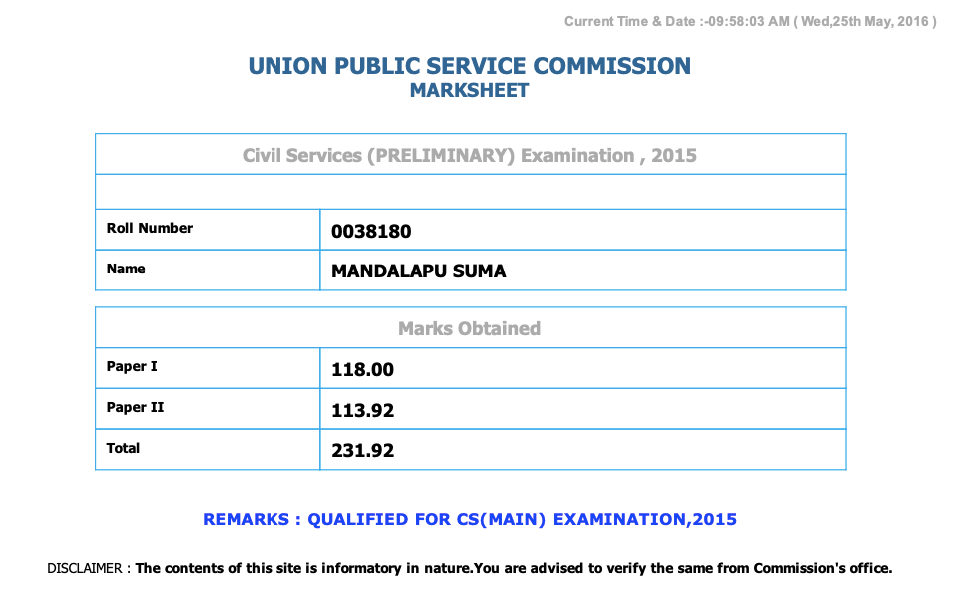
Attempt #1 – 2015
Everything was new and exciting and the aim is set. Energy and efforts were very high. I started solving mocks from 8-10 months before prelims. I remember subscribing to Insights test series back then – they were just starting out so it wasn’t online and they were no digital metrics. I had to take printouts of the mocks, attempt them and evaluate manually. I remember scoring around 55 in my first mock. I laughed at myself. But I worked on it and by the end of those months I could score above 110+ . That was encouraging.
However, one week before the exam – I was totally saturated and gave up prep of any sort and distracted myself with some online rpg game. It had cool graphics and yeah killing monsters is satisfying. (I do not recommend this part) Continuous and consistent preparation (reading NCERTs, standard books and solving mocks) throughout the year before did help me clear it and back then papers were not as unpredictable as now and solving mocks really helped because many questions were repeated from them. This is not the case these days.
I used to be a silent reader on ForumIAS back (it was a very different platform altogether – just a regular online community where aspirants could discuss) and I remember all the inflated cutoffs (130+ in GS) that would circulate for a week or so until people checked various keys and calmed down. I think the cutoff was 105 then. (not very sure about the exact cutoff – you can google and find out)
Tip: If you are a first-timer especially during pandemic preparation and feel stuck and have more than a year to spare – try giving the previous year paper in exam-like conditions – assume that you have given your first attempt and check the result (it would be quite revealing). Reorient your preparation where you find inadequacies and plug-in loopholes patiently and diligently.
Attempt #2 – 2016
Followed my previous strategy of solving a full length prelims test series (Insights again). I competed with fellow aspirants who used to score well in Prelims. That helped maintain rigour and momentum.
The night before the exam I was tensed and I would keep remember some concept or the other I wanted to revise – so middle of the night got up and quickly read about Capital Accounts (related to Balance of Payments) and a question similar to that came in the actual exam.
(I’m not able to find the marksheet – will upload it in the future if I come across it)
Attempt #3 – 2017
Prelims Hubris sets in. Did not practise any full length test series. Just practised some mocks half-heartedly. (I was very let down by my second mains failure – that disillusionment contributed to lack of preparation)
There was some function at home on the eve of the Prelims exam. I did not sleep that night – there was a lot of chaos, many relatives were present who I hadn’t seen for many years. I tried to catch up with them. Lack of sleep affected my exam performance significantly – I felt sleepy one hour into the exam and the questions made no sense – I did not have the capacity to comprehend them. I panicked and marked more questions than I should. I think I missed the cut-off by 3-4 marks.
(I’ll upload the marksheet if I find it – I’m not sure if I saved it)
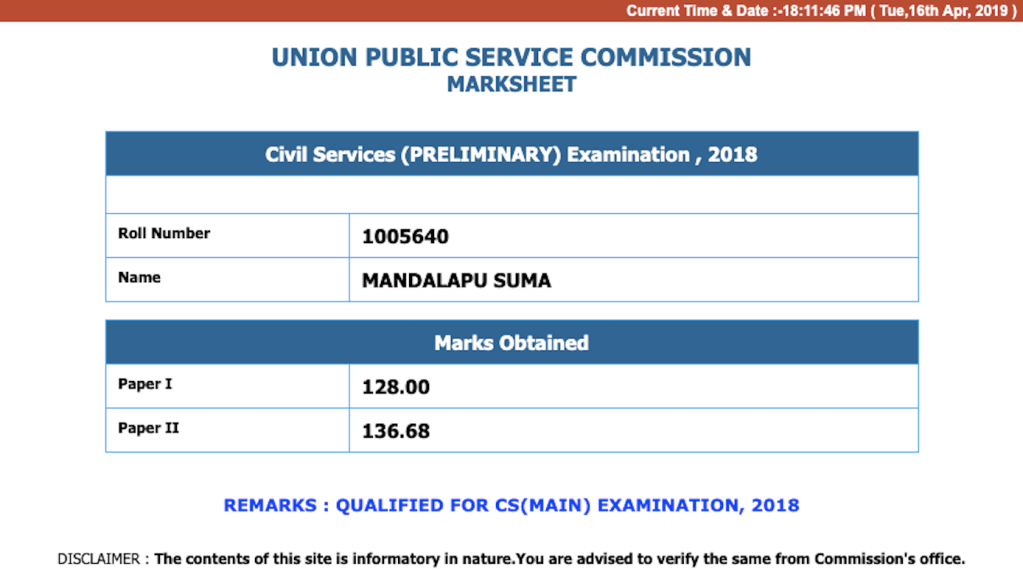
Attempt #4 – 2018
I plugged-in my previous pitfalls. Practised mocks of both Insights and Vision. I specifically worked on my weak areas – in my earlier attempts I did not pay much attention to certain aspects such as rivers and their tributaries and reports. I focused on such areas. I fought for every possible mark. I don’t remember the cut-off exactly but this score was easily 20-25 marks above it.
Salient feature: I kept a small prelims notebook where I noted down information I would either forget or learn newly through explanations from mocks. Just revised this on the last day. (I recommend this but try to keep it brief and don’t bombard yourself with a lot of information)
Attempt #5 – 2019
I did follow the usual routine of solving mocks. However, one lacunae I can recall is lack of their review and revision. (but this was also the case to some extent in other attempts as well). Did not clear prelims. Missed by 2 marks I think.
For the first time I realised how people felt when they could not clear prelims. Till this point, I thought you just needed to solve a certain number of mocks to gain confidence and become comfortable with elimination and educated guesses. I used to see it as a fool-proof strategy. But still things can go wrong. And they did. My understanding and empathy for my fellow aspirants increased.
Attempt #6 – 2020
The time I had to ensure nothing could go wrong from my side:
This was during the pandemic. I was fortunate that I found a good study group – there were six of us split into two groups and we would take turns and question each other on current affairs and standard books (such as spectrum) – it helped with gaining confidence and making good use of time during the Covid crisis in 2020.
I also used to discuss mocks with one of them regularly – we were able to finish Insights mocks and Vision Abhyaas tests.
I also gave All India Open Tests of various institutes – this is a good way to check against getting used to answer patterns of any particular institute’s test series. I was getting decent marks in most of them but sometimes I did score low (around 76) – there is no magic number really because everything depends on the difficulty level of the paper – I think knowing where you stand on the percentile compared to other aspirants is a better metric. Of course with online tests the marks maybe skewed but attempt tests seriously and in exam-like conditions. That is the only way to find out loopholes and plug them properly.
Your marks in the mocks don’t matter – your learning definitely does.
I followed a strict schedule and routine for many months prior to actual prelims. One aspect of this was going to bed on time and waking up on time (around 6-7am). Everything rests on the how well the mind can perform on the prelims day. And sleep is a very crucial aspect to this. I did feel anxiety and nervousness but the months of hard work paid off and I think I got a good solid 6+ hours of sleep the night before the exam.
Although I faced five prelims already – this time I felt more nervous – and the exam paper was quite unpredictable – since I already solved some very unpredictable mocks – I was able to hedge the number of questions I attempted – maintaining calm and composure. (in contrast to Attempt #3)
The qualifying aptitude paper was also difficult and I attempted an all-time low of around 40 questions.
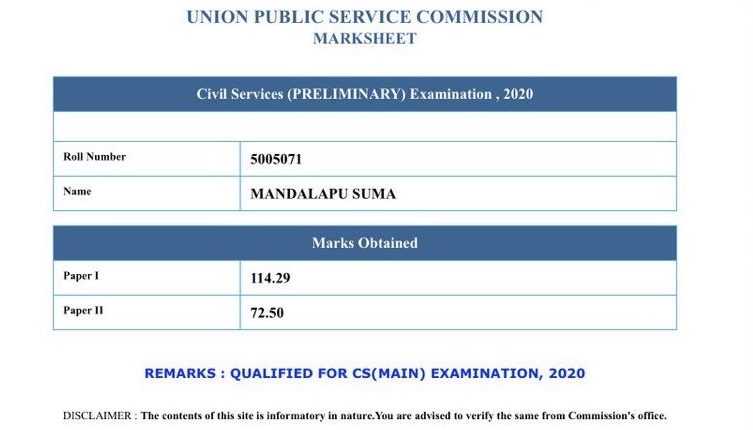
The hedging paid off. I cleared with a good margin I think. (could be somewhere between 110-120)
I’ll upload my mark-sheet once it’s released.
Edit (10/10/21): uploaded the mark-sheet.
My understanding of Prelims and some learnings
As an administrator, sometimes you would have to make important decisions on short notice with inadequate information. To make right decisions in such cases we need to develop an already inbuilt attitude for parsing information, extracting valuable insights and turning them actionable.
In Prelims – no matter how well you prepare half or more of the questions will stump you in one way or the other.
Therefore, ability to eliminate wrong options and ability to take risk on educated guesses are crucial skills to learn for clearing prelims.
In general, it is a good lifeskill to learn how to make better decisions with inadequate and uncertain information.
You learn them through many many iterations of taking mocks – going through where you went wrong and why – where you went right and why and incorporating them in the next iteration such that you make fewer or different mistakes. You should avoid making the same mistakes in future tests. If this is happening, it is a clear indicator that you are not learning from the mocks and the whole effort might go wasted in the end. Even one negative can get you out of the list.
Prelims is a frightful experience – for almost everyone.
Cumulatively I might have solved over these past seven years more than 250+ mocks. That means I solved more than 25000 questions. Even after all of this – during my sixth attempt (probably because there was so much at stake) – It was still a frightful experience.
Hedging
Our general inclination is to use our knowledge. It is natural and tempting. We do spend considerable energy and efforts acquiring such knowledge. Sometimes, this “paisa wasool” attitude creeps in and we might go in a risk-taking spree in the exam. This increases when you panic. And panic increases when you have not prepared properly. Recognise those signs and gain more control of the process through better preparation.
Avoid randomly attempting areas such as Ancient and Medieval Indian History where educated guesses are hard to make. For instance, I used to read ncerts and revised them repeatedly with the intention of not attempting questions in the actual exam. If the questions were not from what I’ve read. I would not attempt them. (I followed this very strictly for ancient and medieval India and every time I didn’t – it costed me dearly)
The Hard Truth
There is no foolproof way to clear prelims but doing the right things, following the right processes increases the odds. And may the odds be in your favour!
If you have stayed till here, thank you – it is a long post but I hope you gained an insight or two. 🙂
 Suma Mandalapu
10 responses to “UPSC Diaries #1: The Prelims Experience”
Nice piece dear 😊..Keep going and shine brightly
Thank you! 🙂
what an insight ,really helpul keep writing .I am sure it will be a great guide for a lot of aspirant.
Thanks Alya! ^_^
Very helpful…..keep guiding
Sure – more posts are coming soon 🙂
That is really an insightful post Suma, you have explained in a very lucid way as to what is required for this exam, the writing was easily able to convey your thought and experience, this article will be enriching for other aspirants, as it will help them to learn from other’s experience in a less time rather than experimenting themselves and coming to conclusions, it is best to learn from other’s and is one of the smart strategies.
It is also a story of fortitude and courage, which every one should develop to face higher challenges in life, where UPSC is a part of life and not life itself !
All the best Suma for all the future endeavours and wish you a happy and healthy life. God bless.
Thank you Tanya! We do not get to read many failure stories but a lot can be learnt from them too! I hope this series shines some light on this generally unlit area of the UPSC journey. 🙂
[…] You can read about my prelims experience here. […]
[…] the uninitiated, please read the prelims and the mains posts for more […]