
You can read about my prelims experience here.
I have appeared in the CSE Mains exam four times – 2015, 2016, 2018 and 2020. I failed to clear it all four times. Similar to the Prelims blog post I would give a brief overview of my four Mains attempts and then comment on what can be learnt from my exposure to them.
Attempt #1 – Mains #1 – 2015
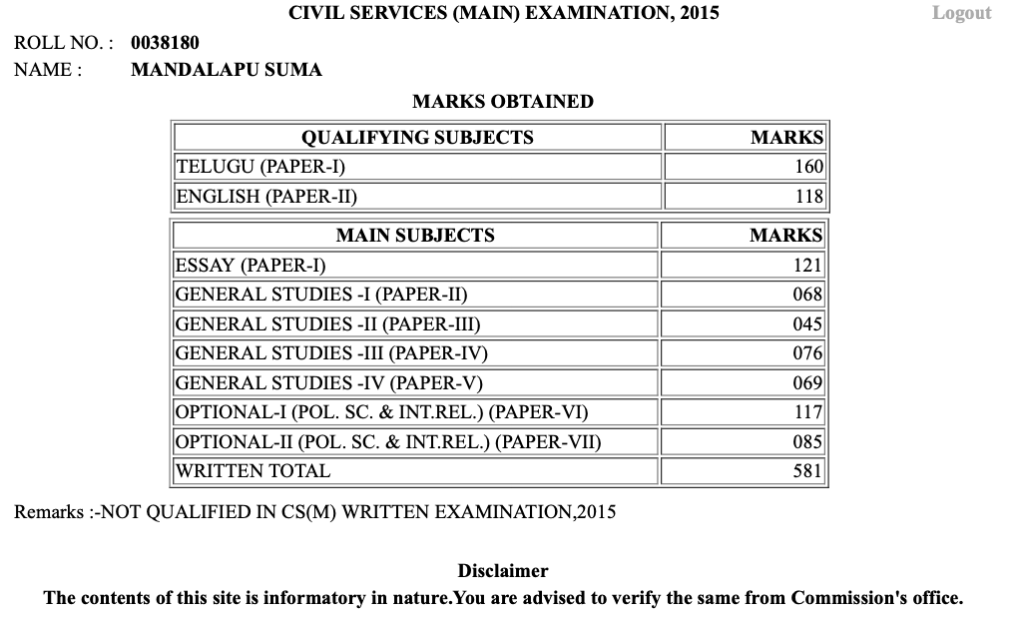
There’s a very good reason why I call it The Mains Debacle because it is. The first paper was the Essay paper and I blanked out for 30min of the 180min exam. Nothing came to my mind when I read the essay topics. I didn’t even know what dole meant. (a word used in one of the essay topics). The first essay I wrote (in the Essay paper) was probably around 500 words (you are supposed to write around 1000 words). I stopped writing it after 90min and switched to the next one (to cut losses).
All of my other papers GS and optional included were, if I were to sum up in one word – “meh”. I wrote them but I didn’t really understand what I was doing. I started the whole UPSC preparation process on my own without coaching or actual guidance from seniors who had cleared or had been preparing. (On hindsight, there are way too many cons with this approach – seek guidance from competent/qualified people before getting into UPSC preparation. I had a rigid mindset of I-will-do-it-on-my-own back then which blinded me to many obvious things.)
While I tried to write mock answers during the phase of mains preparation – I did not know then what is now common knowledge such as structuring, presentation, etc. My self-evaluation did not help. (because of lack of sufficient understanding of the exam). Moreover, I did not join any mains test series. (which is ironic given how religious I was with Prelims test series)
Further, I did not have proper notes for both GS and optional. I used to think reading more number of books would be enough. (don’t do this – it’s a self-defeating exercise)
I missed the cutoff by probably 200 marks.
Attempt #2- Mains #2 – 2016
I corrected my big blunders to some extent in this attempt but not completely. While I did take mains test series for GS and optional, I was not able to complete them or do justice to them.
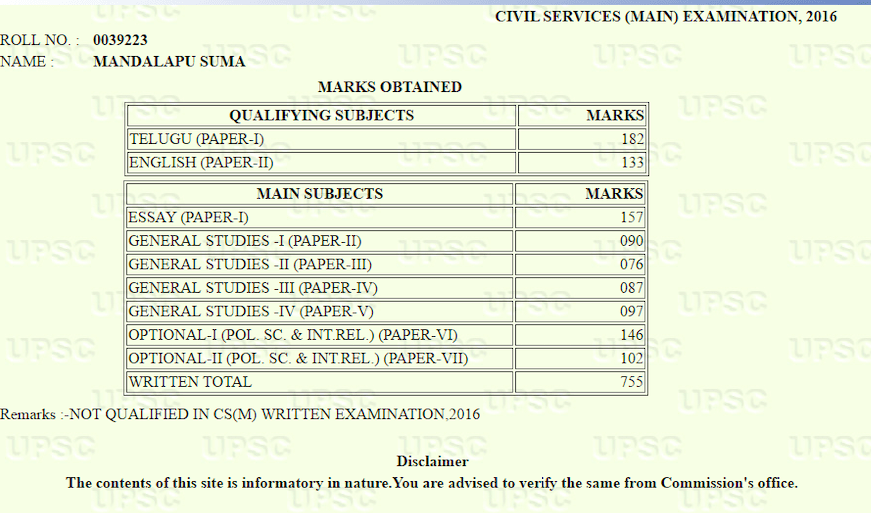
The one paper I really worked on which bore sweet fruit was my essay paper. Those essays remain the best I’ve written till date (I will write a detailed Essay post in the future).
I still was not able to plug in major issues such as having structured and organised revision-friendly notes – my notes were ad-hoc and scattered. I didn’t understand or realise the significance of that particular aspect then.
Mains marks that year were a bit inflated. I missed the cutoff by some 30 odd marks.
Attempt #3 – Mains #3 – 2018
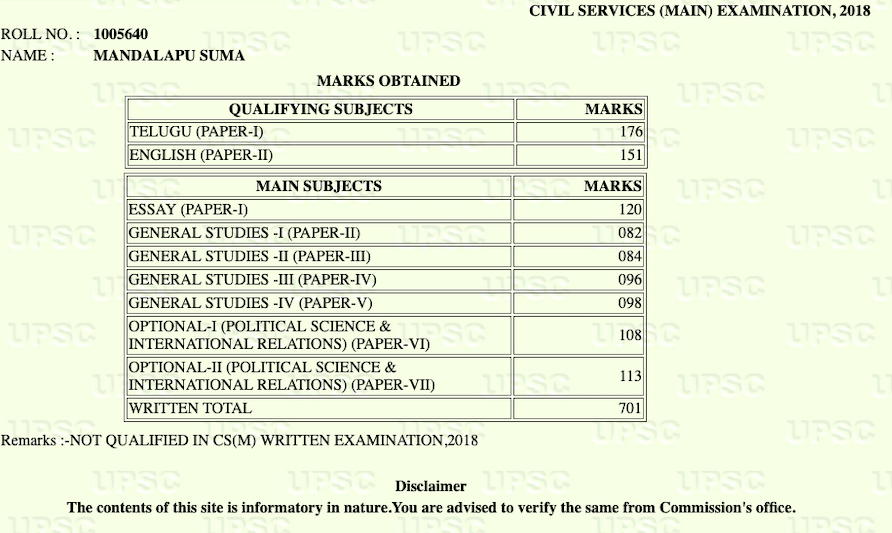
Compared to my previous two mains – I addressed more loopholes but still could not eliminate them. I took two mains test series for GS, did crash course for my optional both 2017 and 2018. I had the notes I needed. But they were still scattered and disorganised. I still did not have any crisp short revision-friendly notes. I also wrote only one mock essay because I was confident I would be able to manage it (this was an incorrect assumption).
The major blunder I had made in this attempt (irrespective of my actual marks) was not reading the instructions for the optional paper. In the excitement of knowing all theory questions – I attempted the first five question sets in PSIR Paper-1 (i.e, from Q1 to Q5). You are supposed to attempt at least one question apart from the compulsory question from the two sections in the paper. (I did not attempt Section B’s questions apart from the compulsory question). In short this meant, I lost claim over 50 marks even though I wrote five question sets. This alone would have put me off the list without any doubt.
My efforts and the final mark-sheet did not correlate as hoped and it was disheartening to see a decrease in marks when I redoubled the efforts.
Attempt #4 – Mains #4 – 2020
My most rigorous preparation till date. It was buttressed by the fact that it was my last attempt. I pushed myself and studied more than all my other attempts put together. But there were many days of panic and anxiety – I enjoyed it some of them but some days were just pure hell. My notes were more comprehensive and somewhat better organised than before but still lacked in proper structure and organisation. (this was my Achilles’ heel)
Fortunately, I had good study partners with whom I could discuss, clarify and understand issues and concepts. I fixed most of the lacunae of my previous attempts. (content, structuring, pain areas in optional, etc.)
However, one major thing I consciously chose not to do was write full length mock tests. Unlike prelims where I could finish mocks in 45min – I would need to spend 3 hours or more actively writing (maybe 6 hours if I were to write two tests in a day) – if one is not used to this process, it could be quite draining mentally and the whole day might just go waste. So, I placed my bet on covering all aspects of the syllabus instead. (the guiding assumption was the issue of lack of proper content in my earlier mains exams). I did however practise writing 2-3 questions daily for most of the days and got them reviewed by competent friends.
I faced time management issues in the actual exams. I also couldn’t remember some statistics and information that I had read and prepared for. Post the exam cycle I felt if I could just have managed to do one more revision I would have done much better justice to the preparation I had done.
Even considering all the aspects above – this was my best attempt.
(I will upload the marks-sheet once it is released.)
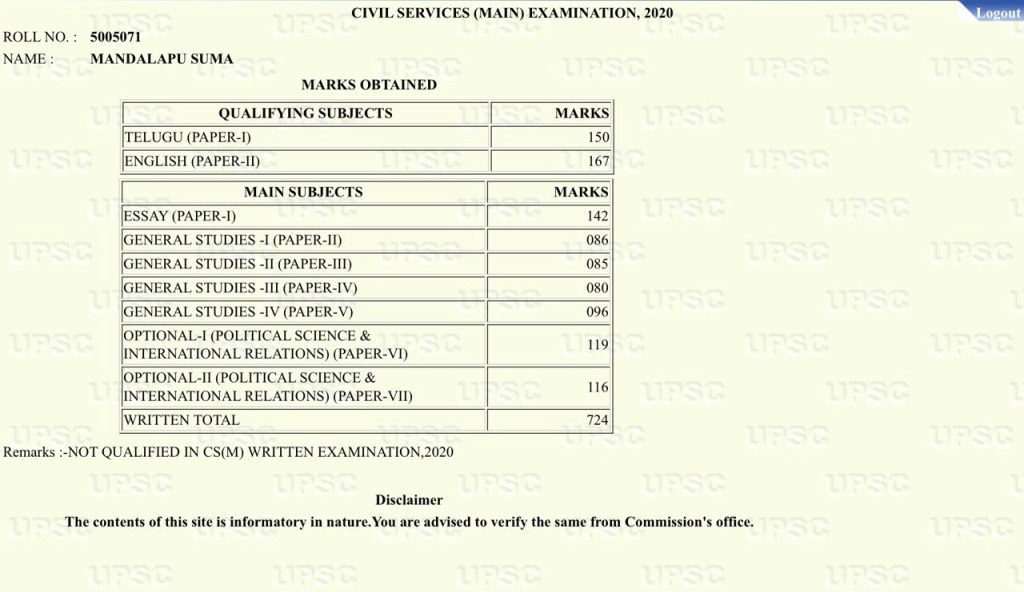
Edit (10/10/21): updated the marksheet – can’t make sense of the marks to be honest (apart from the essay paper). The cutoff for General category was 736. I missed by 12 marks. (this was the closest to the cutoff in all my 4 attempts – well, that should count for something.)
My understanding of Mains and some learnings
Mains is a marathon. Knowing this isn’t enough. Doing the right things here is way more difficult if your mindset is not tuned properly. In my opinion, the right mindset for Mains is focused on the doing aspect – which here is writing mocks.
Content-gathering and the bane of research mode
For you to actual write good/average answers you would need adequate understanding and proper notes. Ideally, these should be prepared before you get into the final 2-3 months of Prelims preparation. Post prelims ideally one should just focus on writing mocks and not become a content-gatherer. The only content one needs to update here would be current affairs. This much is common knowledge but very few people actually do this. You can see that even in my last attempt, I was a content-gatherer.
This usually happens when one has the research mindset – this exam is not for researchers. It is for bureaucrats, who (like I previously mentioned in my Prelims post) have to make informed decisions in a short span of time – which means they would have to train their minds to find the most important details/aspects in the shortest time possible. When a cyclone hits your district, you don’t have the luxury of to do extensive research on what causes them or if global warming is the real culprit while thousands of people become homeless and/or need food and/or shelter.
So, every time you get tempted to do research, stop yourself and ask – how am I going to utilise this in exam? If you do not have a concrete answer (such as I will use this data in questions like so and so, or these points can be used across multiple papers, etc.) then it is better not to get into it.
The pitfalls of intellectual arrogance
Sometimes this research mindset is associated with intellectual arrogance – you would think you know so much because you have read so much. (I’ve read more books per subject than the average and in some cases more that the particular subject’s optional syllabus – [Why? Because I like reading books – In my first attempt instead of revision, I would just pick up a different book on the subject – my mind didn’t like revision at all back then]). This does not mean you know better. If anything, you might know many things but might not even remember the basic details.
For example, you might know lesser known case-laws related to anti-defection but might be unable to recall the provisions in the Constitution made for the same or be might be confused in smaller details like 1/3rd or 2/3rd of members defecting in case of a split. It would show poorly in the actual exam if such is the case.
The most important information to know are the fundamentals. They are necessary but not sufficient.
{Thinking from fundamentals is known as First Principles thinking.}
You would need to build on the fundamentals but without the them, every other layer of knowledge would not be positioned properly and the structure would collapse when faced with crisis situation (the Mains exams). And you would feel overwhelmed and helpless.
This happened to me multiple times in all the Mains I’ve written. I was able to reduce this in my 3rd and 4th Mains, particularly in my 4th Mains where I limited my sources. Still given the vastness of the syllabus and my panic-mode thinking of covering every aspect of the syllabus – I fell short on revision even though I was able to limit the sources. This leads to an important point.
Recognition ≠ Recall
It could be due to my initial intellectual arrogance – I behaved as if I had photographic memory – by which I would just read one source once. Instead of reading one source multiple times, I just read many sources one time. This worked for Prelims where recognition helped in elimination or deducing the right option. But in mains, I was not able to recollect the information. If there is one takeaway from all of my experience – it is this – just read one source multiple times – so much so that you can remember which page had what content. You can add in additional information on the sides to the source (or if they are online notes, you can easily include additional info) but the source content should be memorised and internalised.
For example, being able to recollect major information of Laxmikanth without even having the book.
Frameworks
Taking above example of Laxmikanth. How can you recollect so much information?
This is where structure and organisation comes into play. The foundation of these two can be frameworks. Imagine them like the columns and slabs in a building – without them you wouldn’t be able to build strong floors or walls and the building might easily collapse due to lacking of load bearing capacity. In short, frameworks bear the weight of the information you consume so that you don’t feel the weight, feel burdened and/or overwhelmed.
Further, they will help you navigate content better and make easier interconnections.
Instead of memorising Laxmikanth as a whole (which is not possible). First understand, the contents from the index page. Link them to the syllabus (which you should absolutely memorise). Once this is done, make nested frameworks for each sub-division.
For instance, the framework for Parliamentary System – could be 1. its definition 2. its merits 3. demerits 4. its performance in India (and other countries) 5. measures to address demerits. Then for the merits you can use mnemonics or other memory techniques to remember them.
You have to patiently and diligently do this with everything in the syllabus and keep revising/updating. This is only possible before the final 2-3 months of Prelims preparation. After that, it’s just panic situation and in most cases fire-fighting. Post prelims, make a shorter version of these frameworks with the most essential keywords so that it’s easy to revise. The ideal goal of course is to be able to revise the entire subject or paper’s syllabus in 2-3 hours and to be able to skim through everything in 30min. (that’s the time you might have before the actual exam). Without these second version of keyword/micro notes – you will panic immensely and sabotage your chances in the exam.
Increasing luck surface area
Mains has a lot of subjectivity. Your job is to make it as objective as possible. Results are not guaranteed even after doing everything right. (I’ve known people do what I’ve suggested above and still not make it). But without proper planning and dedicated efforts, you might not be able to analyse where you went right or wrong and blame the most easy and undeniable target – luck.
Instead of thinking luck as some binary entity (it’s either there or not there) – it’s useful to think of it as a continuum – you might increase your chances with better preparation – that one extra point might get you half a mark more – this might get you into the list or might be the deciding factor for getting the service of your choice. The better you become at doing the right but hard things such as making notes and repeated revisions, the greater will be your luck surface area – the higher the chances of you utilising what you know in the exam.
27 hours
At the end of the day, it is what you write in those 9 papers in 27 hours that matters. Not matter how much or how little knowledge you actually have – it is what you show in those 27 hours that will decide your fate.
I already mentioned the importance of writing mocks. Other important and crucial aspects are proper sleep and good food – so that your mind can function its best in those critical hours and you have the energy to pull through and win the multiple battles you will face continuously for those days.
Do not overthink the mistakes already made and only focus on the present paper at any given time during the exam time. Some battles can be forsaken because it is the war which needs to be won. It is the marathon which needs to be finished on time.
The Takeaway
All the above, makes the case for a lot of hard work, discipline and dedication. You would have to put them knowing that the results might go awry.
It is true that there are factors outside of our control which influence the outcome of this exam. But, what is in our control is our efforts.
Have faith in yourself, in the right process focusing on aspects you can improve. And give your very best! Until you give your very best and some more, you will not know what you are capable of. You might also regret it later. This could turn into a lifetime regret – if only I had studied properly back then, or did this or did that.
But once you become used to working hard and pushing your limits you can achieve almost anything. ^_^
May you be able to bring forth your true potential!
This ends yet another long post. Thank you for tuning in! More content coming soon!
 Suma Mandalapu
3 responses to “UPSC Diaries #2: The Mains Debacle”
The best part about your blogs are :
a. How you give a ‘detailed confusion analysis’ 😂like u mentioned that people will get confused …was it 1/3rd or 2/3rd ?
b.you mentioned clearly about the REASERCH mindset (that’s so true ..we often get into )
c. How well you did the detailing about how to approach giving example of parliamentary democracy .
These are few things which make your blogs different from thousand other bloggers out there ..like after reading yours ,it feels like someone is guiding through the unfamiliar terrain which you are about to cross. The beauty is how beautifully you do the detailing it isn’t vague at all .
hahaha …I know my comment is Turning into another ‘BLOG’ itself
But I can’t help. MAM I had to tell you how good you are with this thing
.looking forward to your next blog!!
Thank you!
Its good mam and really helpful for aspirants like us, thank you for your efforts…
Waiting for your next post …keep writing
[…] the uninitiated, please read the prelims and the mains posts for more […]